
INDIVIDUAL RESEARCH PROJECT 4
Cell-cycle regulation of DNA repair
- Home /
- Individual Research Projects /
- Cell-cycle regulation of DNA repair
Abstract
This IRP aims to determine how the plant DNA damage response (DDR) changes during the cell cycle. To examine the role of reparative mechanisms during replication and outside of it, we will utilize PCNA1 protein, showing the distinct pattern in G1/G2 and S phases, genotoxic stress (zeocin/camptothecin – applied via root microfluidic), DDR deficient lines (atr, fas1) and DDR marker proteins MRE11/PARP1.
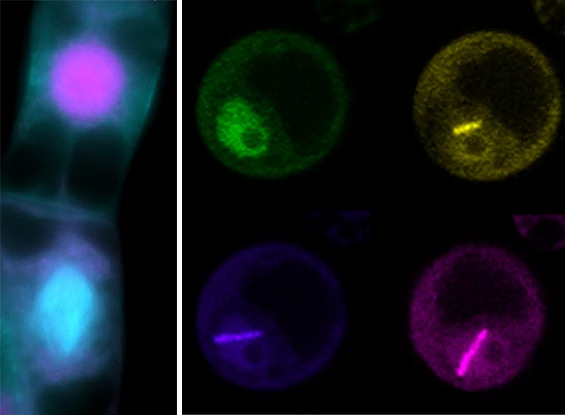
(Obj1) Quantification of PCNA1 association with DNA repair factors MRE11 and PARP1 in wild-type (WT) and mutant lines under control conditions and after genotoxic stress using live imaging (S1). A high-resolution spinning disk confocal system will be employed, and signals will be segmented and tracked using ChromTrack3D (WP3). (Obj2) To determine PCNA1 spatial redistribution after genotoxic stress, the size, intensity and position of PCNA1 foci relative to replication sites (EdU-labelled) will be quantified from superresolution 3D SIM images and a custom image analysis workflow.
More information
Training benefits
- Hands-on work with Arabidopsis thaliana and expertise in DNA damage response (DDR) biology, with a focus on cell cycle–dependent mechanisms.
- Application of genotoxic stress assays (e.g. controlled treatments via root microfluidic systems).
- Advanced live-cell and super-resolution microscopy: spinning disk confocal, STORM, and 3D SIM imaging).
- Quantitative image analysis: segmentation, tracking, and development of custom workflows for protein foci dynamics.
- Experience in protein–protein interaction studies, focusing on PCNA1 and DDR marker proteins
Requirements
We are seeking a highly motivated candidate with a solid background in molecular biology, cell biology, or genetics. The ideal applicant should demonstrate the ability to work independently and have a general interest in microscopy and image analysis.
Environment
CEITEC MU provides state-of-the-art core facilities, expert guidance, and interdisciplinary collaboration, creating a dynamic environment for skill development, high-quality research, and professional growth.